Episode 32: Brad Aimone

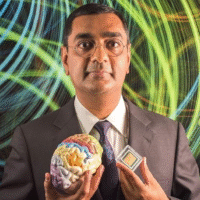
Sunny talks to Dr Brad Aimone from Sandia National Laboratories who works with the world’s biggest neuromorphic platforms. He explains how this allows him to think deeply about what such platforms are good for and how we might be able to get to a theory of neuromorphic computational power. After the interview, discussion follows with Giulia and Ralph. Read More …

Episode 31: Barbara Webb

Sunny talks to Prof Barbara Webb from the University of Edinburgh in Scotland​, who uses physical robots to validate neural mechanisms in crickets, ants, and bees. She talks about her work inspired by the philosophy that biological cognition can only be truly understood by building complete sensory-motor loops that work in the real world. After the interview, discussion follows with Giulia and Ralph. Read More …

Episode 30: Gert Cauwenberghs

Sunny talks to Prof Gert Cauwenberghs, who has been working towards building brain-scale systems for decades. At the University of California at San Diego, he’s now one of the leaders of the Neuromorphic Commons hub, also known as Thor, which will give the wider community access to neuromorphic hardware and simulators. Here he talks about his approach to making systems that use minimal energy, are highly-interconnected at all levels, and surprisingly flexible. Read More …

Episode 29: Gordon Cheng

Sunny talks to Prof Gordon Cheng, Professor of Cognitive Systems at the Technical University of Munich in Germany, who builds humanoid robots that can feel their environment using artificial skin. In this episode he talks about how the skin was designed, how it improves safety, and why neuromorphic engineering will be important for machine autonomy. After the interview, discussion follows with Giulia and Ralph. Read More …
Episode 28: Charlotte Frenkel

Sunny talks to Dr Charlotte Frenkel from the Technical University of Delft. Charlotte set records with a low-power neuromorphic chip she designed as part of her PhD. In this episode of Brains and Machines she talks to Dr Sunny Bains of University College London about what she’s learned about building simplicity into chips and integrity into benchmarks. Read More …

Episode 27: Dharmendra Modha

Sunny talks to Dr Dharmendra Modha, who has pioneered neuromorphic computing at IBM for nearly three decades. He brought the concept of neuromorphic engineering to the wider technical community through his TrueNorth chips and has continued to push field forward. His latest advance, the North Pole inference system, demonstrates remarkable energy efficiency: 75 times more efficient than traditional GPUs. Read More …

Episode 26: Terry Sejnowski

Sunny talks to Dr Terry Sejnowski, who has modelled the brain and used his insights to help inform AI for almost 50 years. He has been involved with neuromorphic engineering since its inception and made fundamental contributions to both neuroscience and engineering. These include demonstrating the importance of precise spike timing in the cortex, and the development of the Boltman machine. In this episode, he explains how information flows both ways between neuroscience and engineered intelligence, proposes a new way of looking at memory, and considers the Hopfield-Hinton Nobel Prize.  Read More …

Episode 25: Jennifer Hasler

Sunny talks to Dr Jennifer Hasler of Georgia Tech, best known for her work with field programmable analog arrays (FPAAs). She’s been developing this analog technology to run spiking neural networks for more than two decades and is now looking to make that technology more accessible to the wider community through her group’s new Python-based analog synthesis tools. Read More …

Episode 24: Brainchip

Sunny talks to Brainchip Chief Technology Officer Dr Tony Lewis, Research Scientist Yan Ru (Rudy) Pei; Senior Research Scientist Olivier Coenen, and Chief Development Officer and Vice President of Engineering, Jon Tapson. They discuss Brainchip’s business strategy, describe their temporal event-based neural networks (TENNs) in detail, and preview the next iteration of the Akida chip. Read More …

Episode 23: Rod Brooks

Sunny talks to Emeritus Professor Rodney Brooks of Massachusetts Institute of Technology, currently CTO of Robust AI, about bottom-up and top-down approaches to robotics and AI. Brooks has been a force in robotics since the 1980s, when he first started to question the status quo of top-down, planning-based AI in favor of more biologically-based approaches. In 1990 he issued a rallying cry for a new generation of roboticists in the form of a paper called Elephants Don’t Play Chess. Since then, he not only rose to be head of the Computer Science and AI Lab at MIT Read More …