Episode 20: Carver Mead

Sunny talks parallelism, neural net efficiency, and risk taking with Caltech’s Prof Carver Mead. Now an Emeritus Professor, Mead has been instrumental in the development of chip design. He worked with Lynn Conway to start the VLSI chip revolution and was one of the first employees of Noyce and Moore, which later became Intel. As well as being a close collaborator with people like Gordon Moore, John Hopfield, and Richard Feynman… Read More …

Episode 19: Four next-gen neuromorphic engineers

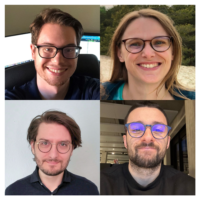
Sunny and Giulia talk to four early career researchers: Dr Kenneth Stewart, a Computer Scientist at the US Naval Research Laboratory in Washington DC; Dr Laura Kriener, a Postdoctoral Researcher at The University of Bern in Switzerland; Jens Pedersen, a PhD student at The Royal Institute of Technology (KTH) in Stockholm, Sweden; and Dr Fabrizio Ottati, an AI/ML Computer Architect at NXP Semiconductors in Hamburg, Germany. Read More …

Episode 18: Dylan Muir

Sunny discusses neuromorphic chips with to the Vice President of Global Research Operations and Program Manager  at SynSense, Dr Dylan Muir. They discuss the company’s products for low-power vision and other sensor processing – including Speck, Xylo, and Rockpool – some of the design choices that were made to bring these to market, and their recent acquisition of sister company IniVation. Discussion follows with Giulia and Ralph. Read More …
Episode 17: Christian Mayr

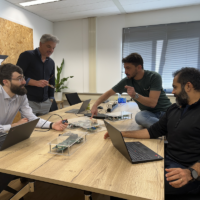
Sunny talks with Prof. Christian Mayr from the Technical University of Dresden, who worked on SpiNNaker with Steve Furber for many years. He is taking that project into the future with SpiNNaker 2—which is mostly built—SpiNNaker 3, which is his next design project, and the startup SpiNNcloud. Discussion follows with Giulia and Ralph. Read More …

Episode 16: Elisa Donati

Sunny talks to Dr Elisa Donati of the Institute of Neuroinformatics in Zurich about biomedical uses for neuromorphic engineering, particularly providing an interface between electronics and the body. They discuss different kinds of interactions that are possible through the nervous system, why spiking networks may be more compatible with biological systems than their conventional counterparts, and a little about the trade-off between network size and neuron complexity. Read More …

Episode 15: Amirreza Yousefzadeh

Sunny discusses neuromorphic chips with Dr Amirreza Yousefzadeh who has most recently worked at Imec and the University of Twente. He has a broad background in electronics, starting with digital and then moving into neuromorphic, and he’s spent time both in industry and research. This sets him up neatly to work on hybrid AI systems-on-a-chip. Discussion follows with Giulia and Ralph. Read More …
Episode 14: Shih-Chii Liu

In this episode Sunny talks to Dr Shih-Chii Liu, co-director of the Sensors Group at the Institute of Neuroinformatics (INI)—part of both the ETH and the University of Zurich, Switzerland. Shih-Chii is a researcher with more than three decades in neuromorphic engineering. She has helped build the field, through her direct research and teaching, but also through her helping to lead community-building projects like the Telluride and Capo Caccia workshops. Read More …

Episode 13: Emre Neftci

In this episode Sunny talks to Prof Emre Neftci, Director of the Neuromorphic Software Ecosystems group at the Peter Grünberg Institute (PGI). He and his colleagues, part of the Jülich Research Centre in Germany, think about how neurons can be trained and organized to learn in an efficient and brain-inspired way. You’ll hear about his work in making backpropagation compatible with spiking neural networks, dealing with device variability, and one- and few-shot learning. Read More …

Episode 12: Chiara Bartolozzi

In this episode, Sunny talks to Dr Chiara Bartolozzi, head of the Event-Driven Perception for Robotics group at the Italian Institute for Technology in Genoa. They discuss how neuromorphic technology can be used to implement attention mechanisms, the importance of embodiment, and why we need a solid theory of how neural systems can work together to create intelligence. Read More …

Episode 11: Tobi Delbrück

Sunny talks to Dr Tobi Delbrück, one of the original neuromorphic engineers from Carver Mead’s team at Caltech. Now a professor at the Institute of Neuroinformatics in Zurich, he has spent his career developing neuromorphic cameras and other technology. You’ll find out how he got started in the field, his work developing the dynamic vision sensor, also known as an event camera, and the pros and cons of sparse representations. Read More …