

Welcome to our podcast covering all sorts of neuromorphic and brain-inspired technology including spiking neural networks, biomimetic robots, and emerging hardware approaches. We welcome your input! Post your suggestions for future episodes, discuss past episodes, and share relevant information on our LinkedIn group.
Brains and Machines is produced in conjunction with EETimes Current.
Episode List
- Episode 42: Ryad Benosman
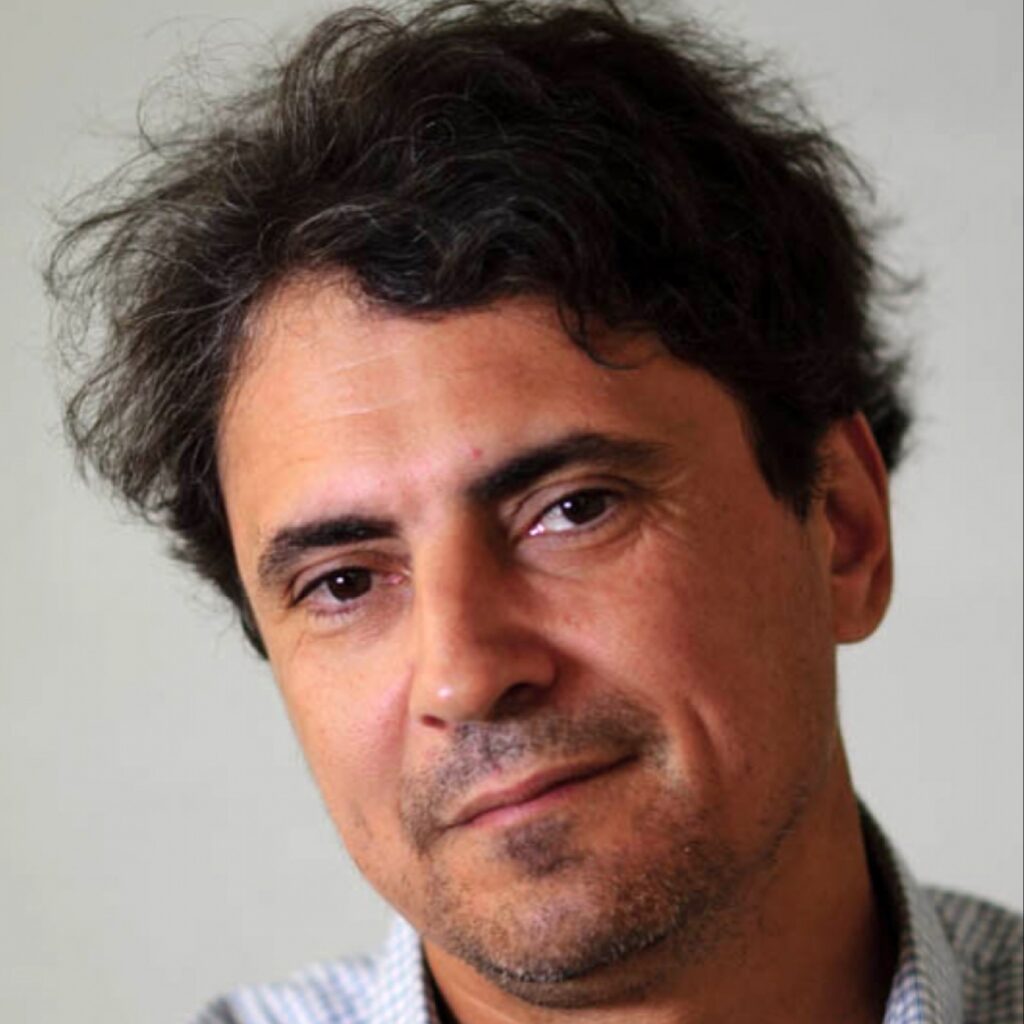 Sunny talks to Dr Ryad Benosman about event-based vision, retinal prosthetics and neuromorphic startups. A co-founder of Prophesee, he explains why he believes AI’s future must come from neuromorphic engineering. After the interview, discussion follows with Giulia and Ralph. Read More …
 - Episode 41: Neuromorphic Hardware and Algorithms panel
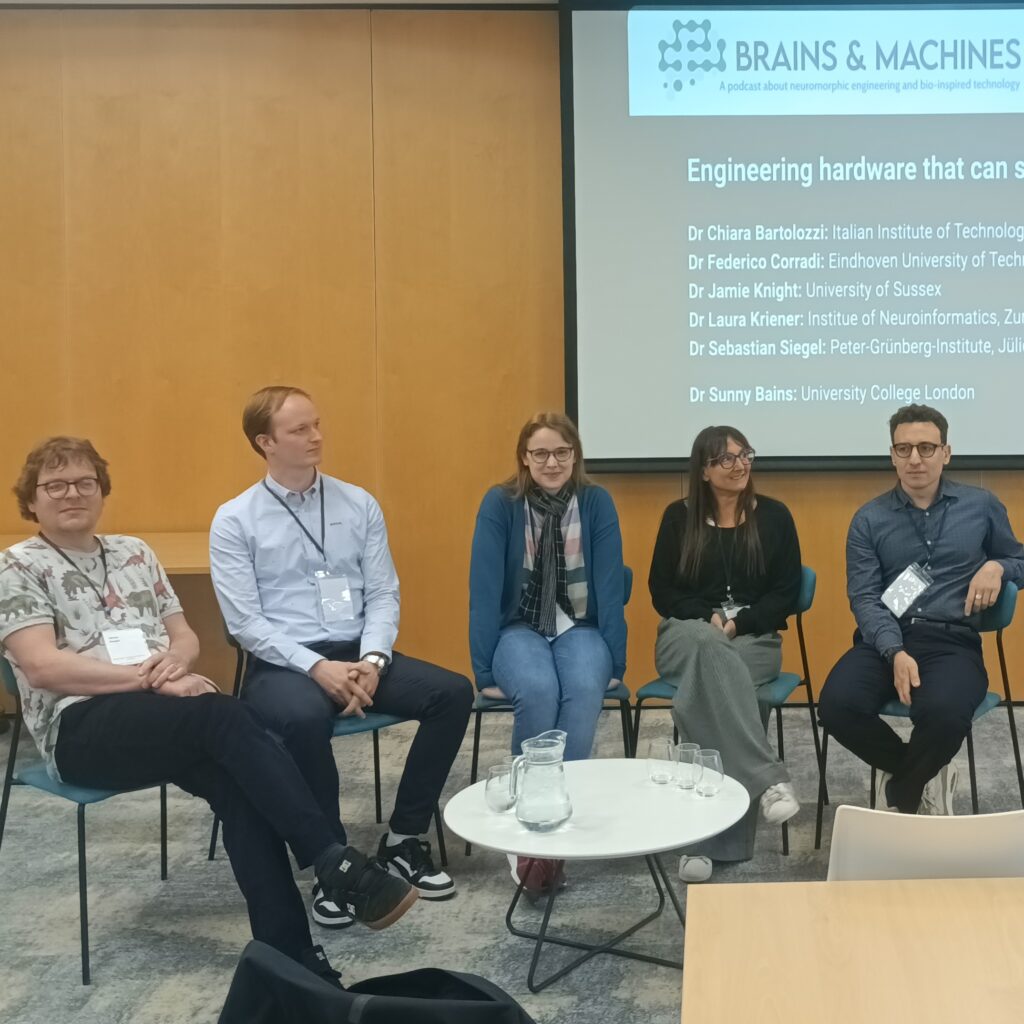 Five engineers debate neuromorphic sensing and learning. Recorded at the Neuromorphic Hardware and Algorithms conference at the University of Sussex, panelists are Chiara Bartolozzi from the Italian Institute of Technology, Federico Corradi from Eindhoven University of Technology, James Knight from the University of Sussex, Laura Kriener from the Institute of Neuroinformatics in Zurich, and Sebastian Siegel from the Peter Grünberg Institute in Jülich. Sunny chairs, and discussion follows with Giulia and Ralph. Read More …
 - Episode 40: Jeff Shainline
 Sunny talks to Jeff Shainline about superconducting neural hardware currently in development at Great Sky in Boulder, Colorado. The new systems will incorporate photonic interconnects and a neuromorphic approach to intelligence. After the interview, discussion follows with Giulia and Ralph. Read More …
 - Episode 39: Patty Stabile
 Sunny talks to Dr Patty Stabile of Eindhoven University of Technology about her optical neural networks with ultra-low-latency processing, and the semiconductor optical amplifiers that make them possible. After the interview, discussion follows with Giulia and Ralph. Read More …
 - Episode 38: Atoms to Bits Panel Discussion
 This episode features a panel discussion on neuromorphic engineering and physical computing held at the Atoms to Bits: The AlphaBet of Intelligence v2.0 conference at the University of Manchester, February 2026. The panellists are Dr Damien Querlioz, Dr Julian Büchel, Prof Tamalika Banerjee, Dr Maxence Ernoult, and Prof Steve Furber, and Sunny chairs the discussion. Discussion follows with Giulia and Ralph. Read More …
 - Episode 37: Sally Ward-Foxton
 Sunny talks to Sally Ward-Foxton, who covers AI chips for EETimes. They talk about the importance of power in all AI systems, the benefit of having dedicated inference chips and where neuromorphic fits into the market. After the interview, discussion follows with Giulia and Ralph. Read More …
 - Episode 36: Rodolphe Sepulchre
 Sunny talks to Prof Rodolphe Sepulchre, a control theorist from the University of Cambridge. They discuss the inspiration he took from studying biological neurons, why both discrete and continuous behaviors are inherent to how they work, and why building neurons is often easier than simulating them. After the interview, discussion follows with Giulia and Ralph. Read More …
 - Episode 35: Neuronova
 Sunny guests are the CEO and CTO of Neuronova: an analog neuromorphic startup based in Milan, Italy. They talk about the company’s technology and strategy, and particularly how very low power can make a very big difference to the sustainability of many applications: particularly audio. After the interview, discussion follows with Giulia and Ralph. Read More …
 - Episode 34: Chris Eliasmith
 Sunny talks to Chris Eliasmith, a computer scientist and philosopher who’s been modelling cognitive systems for almost three decades. They discuss his neural engineering framework and the tools he and his team have developed to implement it, including SPAUN, the semantic pointer architecture universal network, and Nengo, their software interface. Read More …
 - Episode 33: Claudia Lenk
 Sunny talks to Dr Claudia Lenk, whose group creates brain-inspired hearing systems with micromechanical hair cells. They discuss the advantages of the approach and how it can be applied to speech processing in AI. After the interview, discussion follows with Giulia and Ralph. Read More …
 - Episode 32: Brad Aimone
 Sunny talks to Dr Brad Aimone from Sandia National Laboratories who works with the world’s biggest neuromorphic platforms. He explains how this allows him to think deeply about what such platforms are good for and how we might be able to get to a theory of neuromorphic computational power. After the interview, discussion follows with Giulia and Ralph. Read More …
 - Episode 31: Barbara Webb
 Sunny talks to Prof Barbara Webb from the University of Edinburgh in Scotland, who uses physical robots to validate neural mechanisms in crickets, ants, and bees. She talks about her work inspired by the philosophy that biological cognition can only be truly understood by building complete sensory-motor loops that work in the real world. After the interview, discussion follows with Giulia and Ralph. Read More …
 - Episode 30: Gert Cauwenberghs
 Sunny talks to Prof Gert Cauwenberghs, who has been working towards building brain-scale systems for decades. At the University of California at San Diego, he’s now one of the leaders of the Neuromorphic Commons hub, also known as Thor, which will give the wider community access to neuromorphic hardware and simulators. Here he talks about his approach to making systems that use minimal energy, are highly-interconnected at all levels, and surprisingly flexible. Read More …
 - Episode 29: Gordon Cheng
 Sunny talks to Prof Gordon Cheng, Professor of Cognitive Systems at the Technical University of Munich in Germany, who builds humanoid robots that can feel their environment using artificial skin. In this episode he talks about how the skin was designed, how it improves safety, and why neuromorphic engineering will be important for machine autonomy. After the interview, discussion follows with Giulia and Ralph. Read More …
 - Episode 28: Charlotte Frenkel
 Sunny talks to Dr Charlotte Frenkel from the Technical University of Delft. Charlotte set records with a low-power neuromorphic chip she designed as part of her PhD. In this episode of Brains and Machines she talks to Dr Sunny Bains of University College London about what she’s learned about building simplicity into chips and integrity into benchmarks. Read More …
 - Episode 27: Dharmendra Modha
 Sunny talks to Dr Dharmendra Modha, who has pioneered neuromorphic computing at IBM for nearly three decades. He brought the concept of neuromorphic engineering to the wider technical community through his TrueNorth chips and has continued to push field forward. His latest advance, the North Pole inference system, demonstrates remarkable energy efficiency: 75 times more efficient than traditional GPUs. Read More …
 - Episode 26: Terry Sejnowski
 Sunny talks to Dr Terry Sejnowski, who has modelled the brain and used his insights to help inform AI for almost 50 years. He has been involved with neuromorphic engineering since its inception and made fundamental contributions to both neuroscience and engineering. These include demonstrating the importance of precise spike timing in the cortex, and the development of the Boltman machine. In this episode, he explains how information flows both ways between neuroscience and engineered intelligence, proposes a new way of looking at memory, and considers the Hopfield-Hinton Nobel Prize. Read More …
 - Episode 25: Jennifer Hasler
 Sunny talks to Dr Jennifer Hasler of Georgia Tech, best known for her work with field programmable analog arrays (FPAAs). She’s been developing this analog technology to run spiking neural networks for more than two decades and is now looking to make that technology more accessible to the wider community through her group’s new Python-based analog synthesis tools. Read More …
 - Episode 24: Brainchip
 Sunny talks to Brainchip Chief Technology Officer Dr Tony Lewis, Research Scientist Yan Ru (Rudy) Pei; Senior Research Scientist Olivier Coenen, and Chief Development Officer and Vice President of Engineering, Jon Tapson. They discuss Brainchip’s business strategy, describe their temporal event-based neural networks (TENNs) in detail, and preview the next iteration of the Akida chip. Read More …
 - Episode 23: Rod Brooks
 Sunny talks to Emeritus Professor Rodney Brooks of Massachusetts Institute of Technology, currently CTO of Robust AI, about bottom-up and top-down approaches to robotics and AI. Brooks has been a force in robotics since the 1980s, when he first started to question the status quo of top-down, planning-based AI in favor of more biologically-based approaches. In 1990 he issued a rallying cry for a new generation of roboticists in the form of a paper called Elephants Don’t Play Chess. Since then, he not only rose to be head of the Computer Science and AI Lab at MIT Read More …
 - Episode 22: Katie Schuman
 Sunny talks to Dr Katie Schuman of the University of Tennessee about the advantages of evolutionary approaches in neural processing. Until the last couple of years, Katie worked at Oak Ridge National Laboratory focusing on evolutionary optimization, deep learning, data analytics, and of course, neuromorphic computing. Among many other things, Katie is an organizer of ICONS, the International Conference on Neuromorphic Systems. After the interview, discussion follows with Giulia and Ralph. Read More …
 - Episode 21: Innatera
 Sunny talks to four key figures at Innatera, a spin out from the University of Delft in the Netherlands: Dr Petrut Bogdan, Neuromorphic Architect; Dr Amir Zjajo, Chief Scientific Officer; Vasile Toma, Vice President for Engineering; and Dr Sumeet Kumar, Chief Executive Officer. They are hoping that their latest spiking neural network chip will become AI of choice for people working on sensor applications. Read More …
 - Episode 20: Carver Mead
 Sunny talks parallelism, neural net efficiency, and risk taking with Caltech’s Prof Carver Mead. Now an Emeritus Professor, Mead has been instrumental in the development of chip design. He worked with Lynn Conway to start the VLSI chip revolution and was one of the first employees of Noyce and Moore, which later became Intel. As well as being a close collaborator with people like Gordon Moore, John Hopfield, and Richard Feynman… Read More …
 - Episode 19: Four next-gen neuromorphic engineers
 Sunny and Giulia talk to four early career researchers: Dr Kenneth Stewart, a Computer Scientist at the US Naval Research Laboratory in Washington DC; Dr Laura Kriener, a Postdoctoral Researcher at The University of Bern in Switzerland; Jens Pedersen, a PhD student at The Royal Institute of Technology (KTH) in Stockholm, Sweden; and Dr Fabrizio Ottati, an AI/ML Computer Architect at NXP Semiconductors in Hamburg, Germany. Read More …
 - Episode 18: Dylan Muir
 Sunny discusses neuromorphic chips with to the Vice President of Global Research Operations and Program Manager at SynSense, Dr Dylan Muir. They discuss the company’s products for low-power vision and other sensor processing – including Speck, Xylo, and Rockpool – some of the design choices that were made to bring these to market, and their recent acquisition of sister company IniVation. Discussion follows with Giulia and Ralph. Read More …
 - Episode 17: Christian Mayr
 Sunny talks with Prof. Christian Mayr from the Technical University of Dresden, who worked on SpiNNaker with Steve Furber for many years. He is taking that project into the future with SpiNNaker 2—which is mostly built—SpiNNaker 3, which is his next design project, and the startup SpiNNcloud. Discussion follows with Giulia and Ralph. Read More …
 - Episode 16: Elisa Donati
 Sunny talks to Dr Elisa Donati of the Institute of Neuroinformatics in Zurich about biomedical uses for neuromorphic engineering, particularly providing an interface between electronics and the body. They discuss different kinds of interactions that are possible through the nervous system, why spiking networks may be more compatible with biological systems than their conventional counterparts, and a little about the trade-off between network size and neuron complexity. Read More …
 - Episode 15: Amirreza Yousefzadeh
 Sunny discusses neuromorphic chips with Dr Amirreza Yousefzadeh who has most recently worked at Imec and the University of Twente. He has a broad background in electronics, starting with digital and then moving into neuromorphic, and he’s spent time both in industry and research. This sets him up neatly to work on hybrid AI systems-on-a-chip. Discussion follows with Giulia and Ralph. Read More …
 - Episode 14: Shih-Chii Liu
 In this episode Sunny talks to Dr Shih-Chii Liu, co-director of the Sensors Group at the Institute of Neuroinformatics (INI)—part of both the ETH and the University of Zurich, Switzerland. Shih-Chii is a researcher with more than three decades in neuromorphic engineering. She has helped build the field, through her direct research and teaching, but also through her helping to lead community-building projects like the Telluride and Capo Caccia workshops. Read More …
 - Episode 13: Emre Neftci
 In this episode Sunny talks to Prof Emre Neftci, Director of the Neuromorphic Software Ecosystems group at the Peter Grünberg Institute (PGI). He and his colleagues, part of the Jülich Research Centre in Germany, think about how neurons can be trained and organized to learn in an efficient and brain-inspired way. You’ll hear about his work in making backpropagation compatible with spiking neural networks, dealing with device variability, and one- and few-shot learning. Read More …
 - Episode 12: Chiara Bartolozzi
 In this episode, Sunny talks to Dr Chiara Bartolozzi, head of the Event-Driven Perception for Robotics group at the Italian Institute for Technology in Genoa. They discuss how neuromorphic technology can be used to implement attention mechanisms, the importance of embodiment, and why we need a solid theory of how neural systems can work together to create intelligence. Read More …
 - Episode 11: Tobi Delbrück
 Sunny talks to Dr Tobi Delbrück, one of the original neuromorphic engineers from Carver Mead’s team at Caltech. Now a professor at the Institute of Neuroinformatics in Zurich, he has spent his career developing neuromorphic cameras and other technology. You’ll find out how he got started in the field, his work developing the dynamic vision sensor, also known as an event camera, and the pros and cons of sparse representations. Read More …
 - Episode 10: Beatriz Noheda
 Sunny gets deep into nanoscale ferroelectrics with Professor Beatriz Noheda, Director of the Groningen Cognitive Systems and Materials Center. They discuss how this unusual interdisciplinary research center works, why nanoscale ferroelectrics may be useful in brain-like systems, and a little about how they are designed and fabricated. Discussion follows with Giulia and Ralph. Read More …
 - Episode 9: Simeon Bamford
 Giulia talks to Simeon Bamford, a researcher who works on tactile neuromorphic sensors at the Italian Institute of Technology. They talk about creating circuits to perform functions lost to brain damage, Bamford’s involvement with the commercialisation of Dynamic Vision Sensors (DVS), and his latest research on robotic touch. Discussion follows with Sunny and Ralph. Read More …
 - Episode 8: Melika Payvand
 Sunny talks to Professor Melika Payvand who designs neural systems from the circuit-level up at the Institute of Neuroinformatics in Zurich. They discuss the role that memristors play in the systems she designs, why neural circuits need to operate at different timescales, and how copying some features of biological dendrites could add computational power to silicon brains. Read More …
 - Episode 7: Steve Furber
 Sunny talks to now Emeritus Professor Steve Furber as he prepares to leave the University of Manchester. They talk about associative memories, the original SpiNNaker neural simulator designed using densely-interconnected ARM cores, and the new generation of the technology currently being assembled. Read More …
 - Episode 6: Guillermo Gallego
 Giulia talks to Dr Guillermo Gallego: Professor of Robotic Interactive Perception at the Technical University of Berlin, the Einstein Center Digital Future and the Science of Intelligence Excellence Cluster, Germany. They discuss the new generation of bioinspired event-driven cameras, the vision algorithms behind them and why they can be appealing from an application point of view. Read More …
 - Episode 5: Yulia Sandamirskaya
 Sunny talks to Dr Yulia Sandamirskaya, who has just created the Neuromorphic Computing Group at Zurich University of Applied Sciences. They discuss the role that dynamical systems theory plays in robotics, her work at with Intel’s Loihi platform, and what she plans to do in her new position at ZHAW, particularly related to vision. Read More …
 - Episode 4: Giacomo Indiveri
 Sunny talks to Professor Giacomo Indiveri, a stalwart neuromorphic engineer based at the Institute of Neuroinformatics in Zurich, Switzerland. You’ll learn how he sees the trade-offs between analog and digital in the marketplace, the chips he has in the lab and on the drawing board, and — as a purist — the evolution of the term neuromorphic. Read More …
 - Episode 3: Mitra Hartmann
 Sunny talks to Dr Mitra Hartmann: Professor of both Biomedical and Mechanical Engineering at Northwestern University, and head of their Sensory and Neural Engineering Group. They discuss why how modelling rat whiskers can make us better both at understanding the brain and building technology, and why she is finds the neuromorphic engineering community so intellectually rewarding. Read More …
 - Episode 2: Elisabetta Chicca
 Sunny talks to Professor Elisabetta Chicca, head of the Bio-inspired Circuits and Systems Group at the University of Groningen in The Netherlands. They discuss building neural chips with memristors, adding electronic brains to neural robots, some of the current difficulties with learning algorithms for spiking systems and more. Read More …
 - Episode 1: André van Schaik
 Sunny interviews Professor André van Schaik, Director of the International Centre for Neuromorphic Systems at Western Sydney University. They talk about about how neuromorphic engineering has changed since the early ’90s, a new project to help simulate neural and neuromorphic models, and more. Read More …