
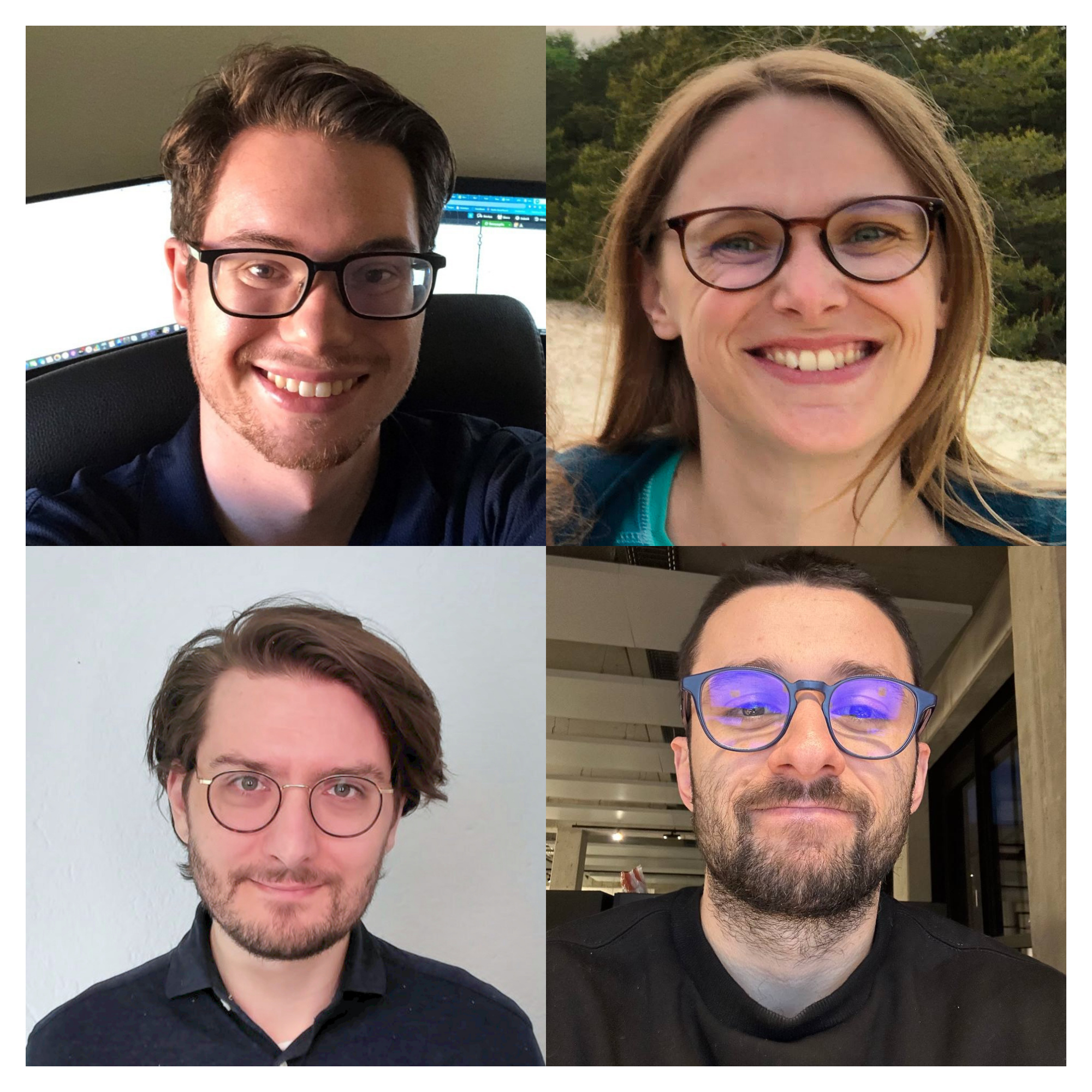
Left to right then top to bottom: Kenneth Stewart, Laura Kriener, Jens Pedersen, and Fabrizio Ottati.

Sunny and Giulia talk to four early career researchers: Dr Kenneth Stewart, a Computer Scientist at the US Naval Research Laboratory in Washington DC; Dr Laura Kriener, a Postdoctoral Researcher at The University of Bern in Switzerland; Jens Pedersen, a PhD student at The Royal Institute of Technology (KTH) in Stockholm, Sweden; and Dr Fabrizio Ottati, an AI/ML Computer Architect at NXP Semiconductors in Hamburg, Germany. They discuss learning rules for spiking neural networks, primitives for computations on neuromorphic hardware, and the benefits and drawbacks of neuromorphic engineering.
Articles and Papers
- Meta-learning spiking neural networks with surrogate gradient descent
- Fast and energy-efficient neuromorphic deep learning with first-spike times
- Neuromorphic Intermediate Representation: A unified instruction set for interoperable brain-inspired computing
- To Spike or Not To Spike: A digital hardware perspective on deep learning acceleration
From the Discussion
- Surrogate Gradient Learning in Spiking Neural Networks: bringing the power of gradient-based optimization to Spiking Neural Networks
- Model-agnostic meta-learning for fast adaptation of deep networks
- Gradient-based methods for spiking physical systems
- AEStream: Accelerated event-based processing with coroutines
- SpikeGPT: Generative pre-trained language model with Spiking Neural Networks
Episode Credits
Producer/Writer: Sunny Bains and Giulia D’Angelo
Co-hosts: Sunny Bains and Giulia D’Angelo
Editor: Rose Gotto
Audio Production: Taylor Marvin, Coupe Studios Music and Sound Design
Music: 3 of Diamonds by Matt Harris
For EETimes.com
This episode is produced in conjunction with EETimes. Podcast reproduced with permission.
